Jump to Section
- Professional whitening achieves up to 8 shades OTC strips can’t match
- Smile Dailey offers Zoom in-office and custom take-home trays
- Yellow and brown stains respond best; intrinsic staining may need a different path
- Zoom takes about one hour; results are visible before you leave the chair
- Some staining doesn’t respond to peroxide; veneers may be the better solution
- Request a consultation with no commitment required
You catch yourself doing it before you even think about it: hand drifting up, head turning slightly, finding any reason not to be in the frame. If you’ve been putting off teeth whitening services, that split-second move is probably why.
You’re not stuck there. Professional treatment options in Little Rock have gotten good enough to actually change that reflex for good. Not the faint lift you get after two weeks of drugstore strips, but a genuinely different smile. At Smile Dailey Dental in the Chenal area, we see people who’ve spent years ducking out of photos walk out with a completely different relationship with the camera.
Once you understand what actually separates professional whitening from what’s on the shelf at the grocery store, the decision usually makes itself.
Professional Whitening vs. the Drugstore Aisle
Over-the-counter strips use low-concentration hydrogen peroxide, typically somewhere between 3% and 14%. They’re built to address surface stains only, coverage tends to be uneven, and whatever improvement you get usually fades within a few weeks.
What you get in a dental office is a different thing entirely. Higher-concentration peroxide gels go on under clinical supervision, with custom-fitted trays or in-office protocols that actually get the whitening agent to every tooth surface consistently. That even coverage is what produces results people notice, not just results you can find if you look hard enough in the right light.
A peer-reviewed systematic review found that professional whitening can achieve up to 8 shade improvements. OTC strips rarely move the needle more than two or three shades, and even that requires flawless application over an extended period.
It’s not only about concentration, though that matters. It’s the combination: stronger formula, full custom coverage, and someone who knows your teeth walking you through the process. With a drugstore strip, if something goes wrong, you’re guessing. Working with a cosmetic dentistry team means the approach is built around your specific smile, not a one-size solution designed to be inoffensive to everyone.
That’s the starting point for what Smile Dailey offers.
What Smile Dailey Offers: Two Professional Options
Dr. Dailey offers two routes to a professionally whitened smile. One happens in the chair. The other fits into your schedule at home. Which approach makes sense depends on how fast you want results, how your teeth handle sensitivity, and what your daily life actually looks like.
In-office Zoom whitening
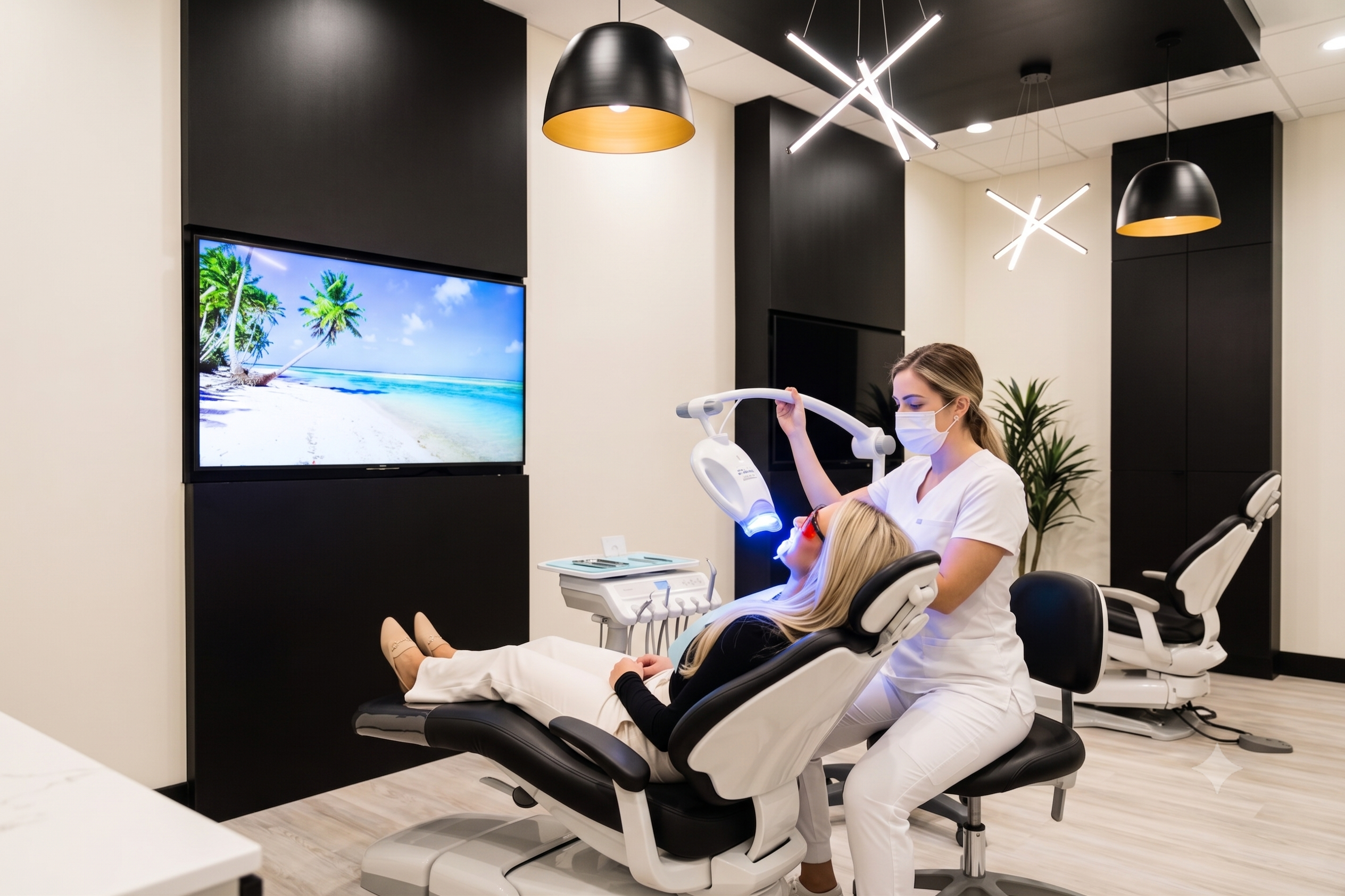
If you want dramatic results fast, this is it. Zoom is a single appointment, about one hour, and the results speak for themselves: up to eight shades brighter before you leave the chair.
Here’s how it works. Dr. Dailey’s team applies a 25% hydrogen peroxide gel to your teeth, then activates it with a blue plasma light. That light-activated combination breaks up deep enamel stains that surface-level products can’t touch. One visit. Real, visible change.
Zoom is currently on special if you’ve been waiting for the right moment. It’s the go-to choice for patients getting ready for a wedding, a reunion, or any professional milestone when you want to walk in with confidence.
Custom take-home whitening trays
Not everyone wants to be in the dental chair for an hour, and that’s completely fine. The take-home option gives you the same professional-grade results on your own schedule.
These aren’t the one-size-fits-all trays from the drugstore. They’re made specifically for your teeth, so the whitening gel sits exactly where it needs to and nowhere it doesn’t. You wear them daily for 10 to 14 days. The results build gradually, which tends to be more comfortable for patients with sensitivity concerns, and easier to control.
Dr. Dailey will walk through both with you at your consultation and, based on where your teeth are starting and what you want out of the result, help you figure out which one actually makes sense for your situation.
Are You a Good Candidate?
Who whitening works best for
Yellow and brown staining is what peroxide-based whitening was designed to treat. The kind that accumulates from years of coffee, tea, red wine, or tobacco responds very well to in-office treatment. If that describes your situation, you’re likely in good shape for exactly the results you’re hoping for.
Who may need a different approach
Gray or bluish staining is a different situation, and it’s worth understanding why. Discoloration from tetracycline use, fluorosis, or old dental trauma is intrinsic, meaning it lives inside the tooth structure itself. Peroxide doesn’t penetrate deeply enough to change it. Johns Hopkins Medicine calls this out specifically as something to understand before you commit to whitening. For that kind of staining, veneers or bonding typically get you further.
Crowns, veneers, and fillings are also worth factoring in. They don’t respond to whitening the way natural enamel does, so if you have restorations near your front teeth, whitening the surrounding teeth can leave you with uneven color. Active gum disease or untreated decay should be resolved before whitening begins.
Dr. Dailey will walk through all of this with you. The ADA recommends a professional assessment before starting, and honestly, that conversation is where a lot of the guesswork disappears.
Sensitivity
Sensitivity doesn’t automatically mean whitening isn’t an option for you. Smile Dailey’s protocols are built with whitening options for sensitive patients in mind, and there are approaches that keep the process comfortable without compromising results.
Once Dr. Dailey confirms whitening is right for you, knowing what to expect at your appointment makes the whole experience easier.
What to Expect: Before, During, and After
Before anything else happens, Dr. Dailey looks at your current shade and talks through what you’re hoping to get out of it. He’s also checking for cavities, gum concerns, or existing restorations that could affect how treatment works. Whitening over an undetected issue doesn’t actually serve you, so that conversation isn’t a formality.
From that conversation, he’ll point you toward whichever option actually fits your life, whether that’s Zoom or a set of take-home trays, and by the end of the appointment, you know exactly what you’re doing before anything gets scheduled.
In the chair, a protective barrier goes over your gum tissue before the whitening gel is applied to your tooth surfaces. The light activation runs in short cycles. The full appointment takes about 45 to 60 minutes, and most people leave noticeably brighter than when they walked in. Not “I think maybe?” brighter. Actually brighter.
In the first 24 to 48 hours after treatment, some mild sensitivity is normal. Coffee, red wine, and dark-staining foods are worth avoiding during that window. After that, results typically hold for one to three years, though diet and habits play a big role. Patients who keep touch-up trays on hand tend to stay on the brighter end of that range. Curious what the results actually look like? The smile gallery is worth a few minutes of your time.
When Whitening Isn’t Enough
Here’s something Dr. Dailey will tell you before you spend a dollar on treatment: not all discoloration responds to peroxide.
Surface staining, the kind that builds up from years of coffee, wine, or tobacco, is exactly what professional whitening is designed to lift. But some discoloration starts inside the tooth. Tetracycline staining from antibiotics taken during tooth development, fluorosis (white or brown spots caused by excess fluoride exposure), and discoloration left behind by old trauma or decay are intrinsic to the tooth structure. Peroxide can’t reach them. Stronger formulas and more sessions won’t change that outcome.
When whitening won’t get you to the result you’re after, porcelain veneers are usually the more honest conversation. Veneers bond directly to the front surface of the tooth and address color, shape, chips, minor gaps, and alignment all at once. One solution, several concerns handled.
Dr. Dailey will tell you plainly which path actually gives you the smile you’re picturing. That conversation costs nothing and can save you from investing in something that won’t move the needle for your specific situation. If whitening is right, you’ll know. If something else makes more sense, you’ll know that too.
Ready to See What a Brighter Smile Can Do?
A lot of patients in West Little Rock, Chenal, and across Central Arkansas sit with the same quiet hesitation for a long time before they finally bring it up. Sometimes it’s a specific event that moves them: a friend’s wedding coming up, a reason to be in front of a camera. Sometimes there’s no occasion at all; they just got tired of feeling self-conscious about something that’s actually fixable. Either way, the conversation with Dr. Dailey starts in the same place: where your teeth are now, and what you’d actually like to feel different about.
That’s it. No pressure, no commitment. Request a consultation and walk out knowing exactly what’s possible.
Questions we hear about teeth whitening in Little Rock
How long do professional whitening results last?
Most patients enjoy results for one to three years, with diet, tobacco use, and maintenance habits as the main variables. Touch-up trays and periodic professional sessions keep results lasting toward the longer end of that range.
Will whitening work on my crowns or veneers?
No. Whitening gel only affects natural tooth enamel, not porcelain or composite restorations. If your crowns or veneers are visibly darker than your natural teeth after whitening, that’s a separate conversation Dr. Dailey can help you think through.
Is professional whitening safe for sensitive teeth?
Yes, with the right approach. Dr. Dailey evaluates sensitivity before recommending a treatment and can adjust the gel concentration or session length accordingly. Any sensitivity that does occur after treatment is typically mild and resolves within a day or two.
How is Zoom whitening different from whitening strips?
The difference comes down to concentration, fit, and activation. Zoom uses a professional-strength gel that over-the-counter strips can’t legally match, applied with custom trays that cover every surface evenly. The light-activation step accelerates the whitening process in a way strips simply can’t replicate. The result is faster, more even, and more lasting than anything you can buy at a pharmacy.