
After Teeth Whitening Needs to Know:
- What Happens to Your Teeth Right After Whitening: the science behind why the first 48 hours define your results
- The White Diet: Foods and Drinks to Protect Your Results: what to eat (and avoid) when your enamel is at its most vulnerable
- Managing Sensitivity After Teeth Whitening: why your teeth feel different, and how to get comfortable fast
- Daily Habits That Protect Your Whitening Investment: simple routines that keep your smile looking freshly whitened longer
- How Long Do Whitening Results Last?: the honest timeline, and what actually moves the needle on longevity
- Whitening Questions Patients Ask at Smile Dailey: answers to the questions patients ask most after leaving the chair
Your smile looks different now. Brighter. More you. That confidence you feel walking out after a whitening appointment is exactly what the experience is designed to create, and protecting it starts the moment you leave the chair. The right aftercare makes the difference between results that last weeks and results that last months.
Whether you just experienced laser teeth whitening at Smile Dailey Modern Dentistry or you’re preparing for your first appointment, the hours and days that follow treatment are when your choices matter most. Dr. Dailey has spent decades helping Central Arkansas patients achieve and maintain beautiful smiles. He’s been recognized as Best of the Best Cosmetic Dentist 17 times (& counting!), and a big part of that reputation comes down to what happens after patients leave the chair, not just what happens in it.
Here’s what most people don’t realize: those first 24 to 48 hours are where your results are actually locked in. What you eat, what you drink, how you treat your teeth in that window, all of it shapes how bright your smile gets and how long it holds. This guide walks you through everything, practically and plainly.
What Happens to Your Teeth Right After Whitening
Right after whitening, your teeth are in a temporary state of heightened brightness and heightened vulnerability at the same time. Understanding why turns aftercare from a list of restrictions into something that actually makes sense.
The whitening process works because peroxide-based agents penetrate your enamel and break apart stain molecules. As a side effect, this temporarily opens microscopic pores in your enamel surface. A peer-reviewed NIH study confirms that hydrogen peroxide causes measurable, temporary changes to enamel surface structure. Your enamel is not damaged, but it is in a different state than usual, and that state has real practical consequences.
Your teeth also lose something called the acquired pellicle during treatment. The pellicle is a thin protein film that naturally coats your enamel, forming from proteins in your saliva. It acts as a partial barrier between your enamel and the outside world. Whitening strips it away. Your saliva will rebuild it over roughly 24 hours, but until it does, your enamel is more exposed than it typically would be.
These two changes together create what many dentists call the “white window.” Your teeth are at peak brightness, and your enamel is also at peak openness. The same microscopic porosity that allowed the whitening agent to do its work will now absorb pigment from food and drink far more readily than usual. A dark berry, a sip of coffee, a glass of red wine: each one contacts enamel that is temporarily more receptive to staining.
Temperature sensitivity follows the same logic. Open pores mean the nerves inside your teeth register temperature changes more acutely. If your teeth feel more reactive to cold water or air than usual, that is a normal, temporary response tied directly to this physiological window.
The practical takeaway: the 24 to 48 hours after whitening are not arbitrary caution. They reflect a real, documented biological state. Protecting that window is the single highest-leverage thing you can do for your whitening results.
What you eat and drink during that window matters enormously, and that is exactly where the white diet comes in.
The White Diet: Foods and Drinks to Protect Your Results
The white diet is straightforward: for 48 hours after whitening, stick to light-colored, low-pigment foods and drinks. Whitening temporarily opens the microscopic pores in your enamel, and during that window, your teeth absorb pigment far more readily than usual. Dark foods and drinks that you’d normally brush off without a second thought can work their way in and dull your results before they’ve had a chance to fully set.
It’s a short commitment for a return that lasts. You’ve already done the hard part; two days of mindful eating is how you make sure it holds.
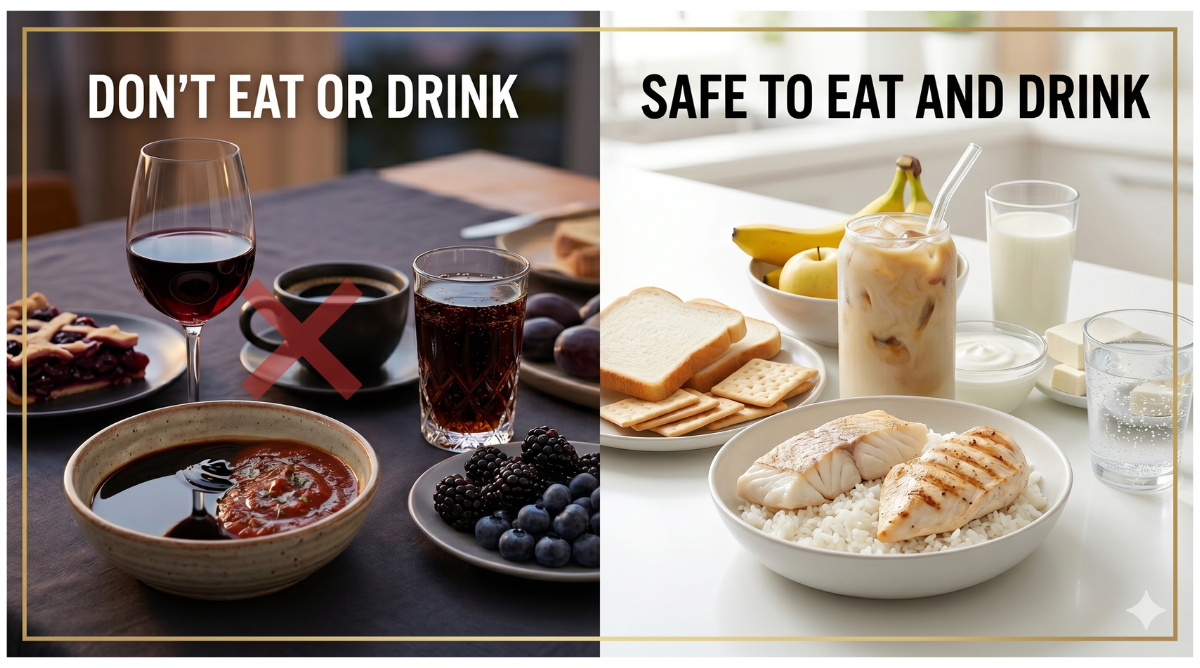
Foods and drinks to avoid for the first 48 hours:
- Coffee, black tea, dark sodas
- Red wine
- Dark berries: blueberries, blackberries, cherries
- Dark sauces: soy sauce, balsamic vinegar, tomato sauce (sorry spaghetti)
- Colored sports drinks and fruit juices
- Anything with strong artificial coloring
- Acidic foods like citrus and vinegar-based items, which soften enamel further when pores are open
Foods and drinks that are safe:
- Chicken, turkey, white fish
- Rice, pasta with light or white sauce
- Bread and crackers
- Bananas and peeled apples
- Milk, yogurt, white cheese
- Still or sparkling water (unflavored, uncolored varieties only)
After 48 hours, as your tooth pellicle regenerates and enamel pores close, most of those restrictions ease considerably. Sweet tea and dark roast coffee are a way of life in Arkansas, and no one is asking you to give them up permanently. The longer-term habit is a simple one: rinse with water after dark drinks, or use a straw to minimize contact with your enamel. That small adjustment goes a long way toward keeping your whitening results bright.
Sensitivity is a common companion to whitening results, and the next section covers exactly what to expect and how to stay comfortable.
Ouch! Managing Sensitivity After Teeth Whitening
Some degree of sensitivity after whitening is expected, and for most patients it passes quickly. The discomfort rarely lasts more than a few days, and understanding what’s driving it makes it easier to manage.
Your teeth have tiny channels inside the enamel called dentinal tubules. They run from the outer surface toward the nerve, and under normal circumstances they’re largely inactive. Whitening agents containing peroxide temporarily widen those channels, which makes the nerve more responsive than usual to temperature and pressure. If your teeth feel sharp or achy when you drink cold water the day after treatment, that’s the mechanism behind it. It isn’t damage; it’s a predictable response to peroxide.
How long that sensitivity lingers depends largely on the type of whitening you had. For most patients, the American Dental Association notes that discomfort typically clears by the fourth day. In-office professional whitening uses higher peroxide concentrations, so some patients experience sensitivity for up to one to two weeks, consistent with what clinical research on post-whitening sensitivity has found. Either way, the window is finite.
There are a few straightforward things that help while you’re in it:
- Potassium nitrate toothpaste (Sensodyne is the most common option) used during and after treatment to calm nerve response
- Avoiding very hot and very cold foods and drinks for the first several days
- Over-the-counter pain relief as needed
- Skipping acidic foods, which amplify sensitivity when enamel is in this temporarily heightened state
If you already experience sensitivity before whitening, that’s worth a conversation with Dr. Dailey before you begin. There are preparation approaches that make the process considerably more comfortable, and the considerations involved are covered in more detail at teeth whitening for sensitive teeth.
One reframe worth holding onto: sensitivity is a sign the whitening worked. The responsiveness is temporary. It resolves. And the habits covered in the next section, applied consistently, are what keep your results bright long after that window closes.
Daily Habits That Protect Your Whitening & Confidence Investment
Most patients leave their whitening appointment focused on the 48-hour recovery window, which makes sense. But the habits that actually determine whether your results last six months or two-plus years are the ones you build into your regular routine after that window closes.
A low-abrasion whitening toothpaste is worth using daily. It’s not dramatic, but it keeps surface brightness from quietly retreating between treatments without wearing down enamel the way higher-abrasion formulas can.
For coffee, tea, and cola drinkers: a straw makes a genuine difference. Not because you’re giving anything up, but because it redirects the liquid past the front surfaces where staining accumulates. The difference adds up over a week’s worth of morning coffees.
After a glass of red wine or your morning coffee, a 30-second water rinse is worth the habit. Surface pigments from those drinks haven’t fully bonded yet; rinsing catches them first.
Regular professional cleanings at Smile Dailey are where a lot of this compounds. Beyond the standard benefits, cleanings clear away the surface staining that gradually builds between whitening sessions, which actively protects the investment you’ve already made. Dr. Dailey can also track how your enamel responds over time.
Custom at-home touch-up trays are something Dr. Dailey recommends a lot, especially for patients who want to hold onto their results between visits. Fitted trays take maybe a few minutes a few times a month. That’s enough to keep things looking fresh without scheduling a full appointment every time you notice things starting to dull.
On tobacco: it’s worth naming directly because it works faster than almost anything else to reverse whitening results. Reducing or eliminating it protects everything else on this list.
The daily habits that actually protect your results long-term are worth reading through, and the oral hygiene tips guide lays them out clearly, well past the initial recovery window.
None of this requires a major shift. A few small adjustments, applied consistently, is really all it takes. The natural next question: how long should those results realistically hold?
How Long Can Whitening Results Last?
Most patients at Smile Dailey hold their results anywhere from one to three years. Where you fall in that range comes down to two things: how your enamel responds to treatment and what your daily habits actually look like.
In-office whitening gives you the strongest starting point. Take-home kits work too, but they tend to fade faster, usually somewhere in the six-to-twelve-month window. Consistency matters more than most people expect with those.
Honestly, longevity comes down to your habits more than anything else. Coffee and tea are the biggest offenders, especially if you’re nursing a cup throughout the morning without a straw. We know caffeine is the morning nectar of life, but for optimal results, it’s best to go from hot to cold and grab a straw. Red wine and tobacco work against your results, too. What a lot of people don’t think about: skipping cleanings lets surface staining quietly accumulate between visits, and certain medications can affect enamel in ways that shorten the timeline without any obvious signal that it’s happening.
Well-timed touch-ups do more than maintain your results. They restore brightness in a way that feels effortless, often with just one in-office session every 8 to 12 months. For patients who’d rather keep things flexible, Smile Dailey also has custom take-home trays so routine maintenance doesn’t require a standing appointment.
Dr. Dailey tracks how your specific enamel responds over time. That shapes the guidance you get at each appointment. It’s not a generic schedule handed to everyone who walks in. That kind of continuity is part of why the results speak for themselves in the smile gallery.
If you want those results to last, the next section covers teeth whitening aftercare tips and the questions patients ask most once treatment is done.
Whitening Questions Patients Ask at Smile Dailey
Can I drink coffee after teeth whitening?
Give it 48 hours before you reach for that morning cup. Here’s the thing: right after whitening, your enamel pores are temporarily more open, which makes them far more likely to pull in pigment. That doesn’t mean coffee is off the table forever, though. Once that window closes, a straw and a quick water rinse after your cup will go a long way toward protecting what you’ve invested in.
How long does sensitivity last after whitening?
Fair question, and the answer depends a little on what kind of treatment you had. For most people, sensitivity fades within three to four days, which lines up with what the American Dental Association reports. In-office treatments use a more concentrated formula, so lingering sensitivity for up to one to two weeks isn’t unusual. Clinical research on post-whitening sensitivity backs up that range. One thing that genuinely helps: start using potassium nitrate toothpaste twice a day a few days before your appointment. Patients who do that tend to walk out of the chair a lot more comfortable.
Can I brush my teeth right after whitening?
Yes. Just be gentle about it. For the first 24 to 48 hours, grab a soft-bristled brush and keep the pressure light. Your enamel is more open during that window, so scrubbing hard can cause more irritation than it would on a normal day. Light, thorough strokes still get the job done.
When can I eat normally after teeth whitening?
The 48-hour mark is where things open back up. During that first stretch, staying with lighter, less pigmented foods protects your results at the moment they’re most vulnerable. After that? Honestly, you don’t have to overhaul your diet. A straw for dark drinks, a rinse after meals, a little awareness here and there. Those small habits keep your whitening results working without putting much off-limits at all.
How often should I whiten my teeth?
Professional in-office treatments typically fit well into a once or twice-a-year schedule. In between, Dr. Dailey’s customized take-home trays give you a gentler way to maintain your results whenever your smile starts to fade a bit. The thing to watch: whitening too frequently can ramp up sensitivity over time. Staying in regular conversation with your dental team means you get consistent results without pushing past what’s comfortable for your teeth.
Your Bright Smile Deserves to Stay That Way
Dr. Dailey and the team at Smile Dailey Dental have walked a lot of Little Rock patients through exactly this process. Whether you’re thinking about a touch-up or you’re curious what else is possible through our cosmetic dentistry services, they’re ready to talk it through whenever you are.

Smile Dailey Modern Dentistry, your premier Chenal dental clinic, is located at
17200 Chenal Pkwy Ste. 250, Little Rock, AR 72223. Call us at 501-448-0032 or visit